Rose tattoos are commonly associated with love, beauty, affection, remembrance, passion, growth and personal transformation, but there is no single meaning that applies to every design. The meaning can change according to color, style, placement, accompanying symbols and personal interpretation.
That flexibility is one reason roses work across so many tattoo styles.
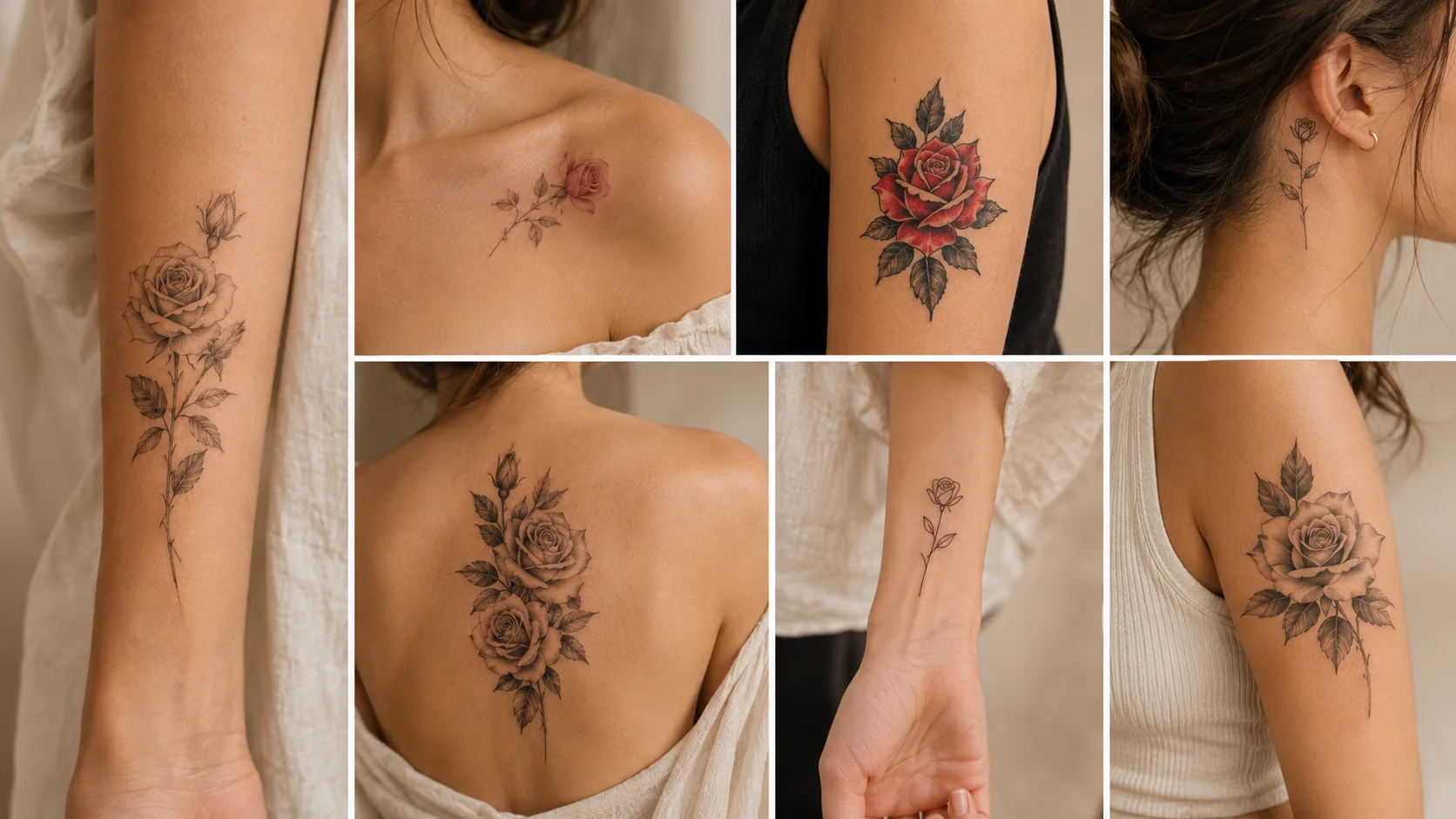
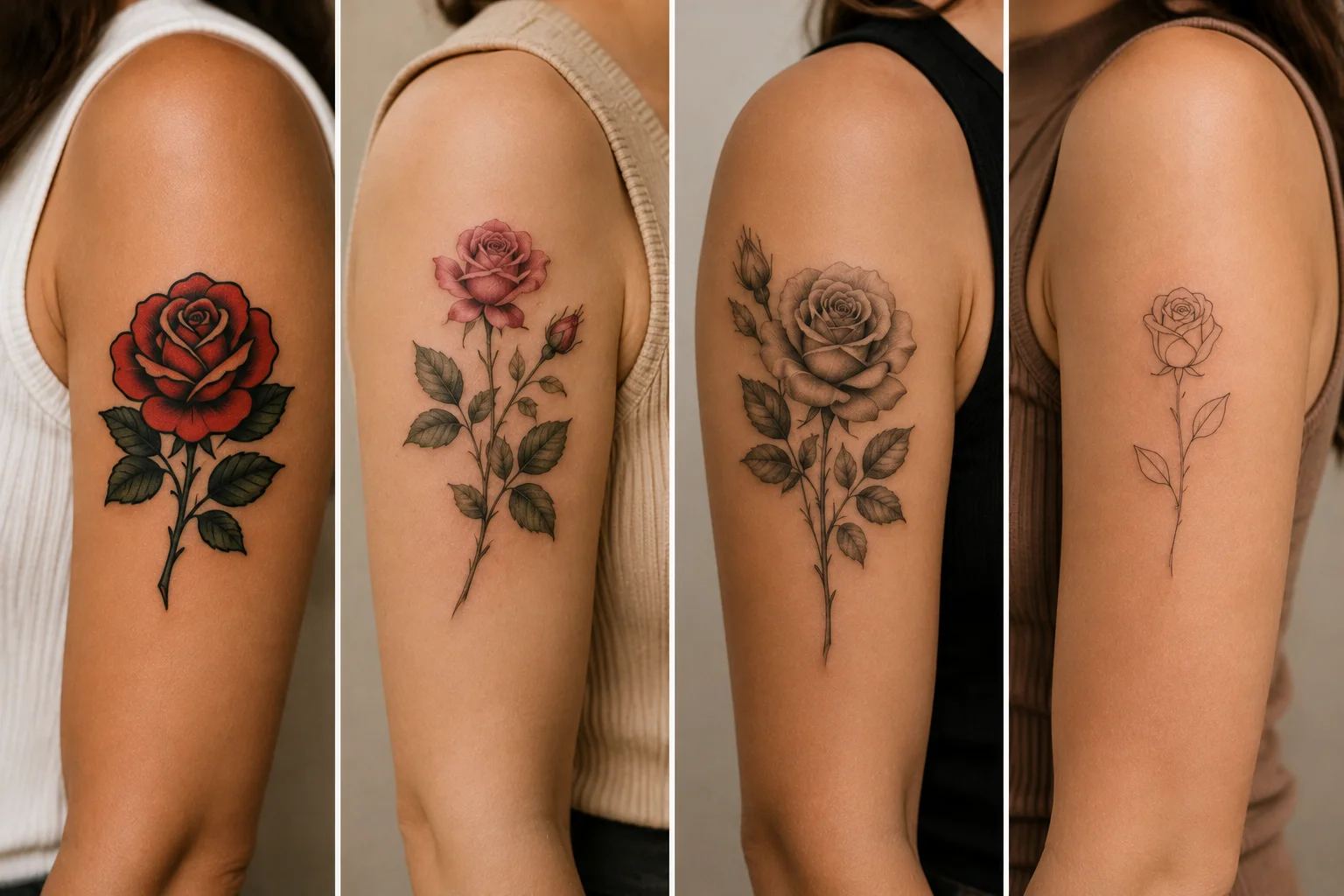
A rose can become a tiny fine-line wrist tattoo, a traditional red-and-green design, a realistic black-and-grey forearm piece, or part of a larger botanical composition. The same flower can look romantic, understated, dramatic, memorial, modern or deeply personal depending on how it is designed.
Rather than choosing a rose because one website assigns it a fixed definition, start with what the flower means to you.
What Does a Rose Tattoo Mean?
A rose tattoo can represent love, affection, beauty, remembrance, passion, strength, growth or transformation. These associations are common, but they are not universal rules.
The rose has a long history as a symbolic flower. Kew describes red roses as one of the most recognizable symbols of love, while the Metropolitan Museum of Art notes that the rose gained many meanings through religion, mythology and the historical “language of flowers.”
For tattoo purposes, however, meaning often becomes more personal.
A rose might represent:
- A relationship
- A family member
- A memorial
- Personal growth
- An anniversary
- Beauty after difficulty
- A new stage in life
- Self-love
- A connection to a specific person or memory
If you are still comparing different flowers before deciding, PureInk’s guide to meaningful flower tattoos gives a broader overview of floral symbolism.
Rose Tattoo Meaning at a Glance
| Design or color | Common association | Overall design feel |
|---|---|---|
| Single rose | Love, individuality, remembrance | Classic and focused |
| Red rose | Love, passion, romance | Bold and expressive |
| Pink rose | Admiration, affection, gratitude | Soft and elegant |
| White rose | Innocence, truth, remembrance | Clean and understated |
| Yellow rose | Friendship, warmth, positive connection | Bright and cheerful |
| Black or dark rose | Loss, transformation, mystery, personal strength | Dramatic and introspective |
| Rosebud | Beginnings, potential, something still unfolding | Delicate and symbolic |
| Blooming rose | Growth, maturity, beauty, transformation | Full and expressive |
These meanings should be treated as interpretive associations rather than fixed definitions. Historical flower symbolism varied across place and period, and modern tattoo meaning can differ again.
The Royal Horticultural Society, for example, associates red roses with love, pink with admiration and gratitude, white with truth and innocence, and yellow with friendship and caring in its educational material on flower symbolism.
Popular Rose Tattoo Ideas
The strongest rose tattoo is usually not the one with the most detail. It is the one whose style, scale and placement work together.
Single-Stem Rose Tattoo
A single-stem rose uses one bloom with a narrow stem and, optionally, leaves or thorns.
It works particularly well for someone who wants a design that feels clean and intentional without becoming too simple.
A medium or elongated design can suit:
- Forearm
- Upper arm
- Rib area
- Ankle
- Calf
You can personalize the stem with a date, initials, handwriting or a subtle break in the line.
Small Rose Tattoo
A small rose tattoo works best when the flower is simplified rather than compressed.
Instead of trying to fit every petal, thorn and leaf into a tiny space, focus on the rose’s recognizable silhouette.
Good placements include:
- Wrist
- Ankle
- Inner arm
- Shoulder
- Collarbone
A tiny rose can represent a private memory, a first tattoo or simply a preference for understated floral artwork.
Fine-Line Rose Tattoo
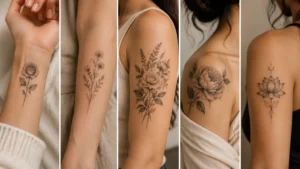
Fine-line roses use thin outlines and restrained shading.
This creates a delicate, modern appearance that works especially well for people who like subtle floral tattoos.
A fine-line design can include:
- One open rose
- A long stem
- One or two leaves
- Minimal shading
- A small date
- A short word
If you like this style more broadly, explore PureInk’s floral tattoo ideas for other flowers that translate well into fine-line designs.
Minimalist Rose Tattoo
A minimalist rose reduces the flower to its essential form.
Instead of realistic petal layers, the artist may use:
- A few clean curves
- A simple bloom
- One stem
- Limited shading
- Plenty of negative space
Minimalist roses work well when you want the design to feel symbolic without becoming visually busy.
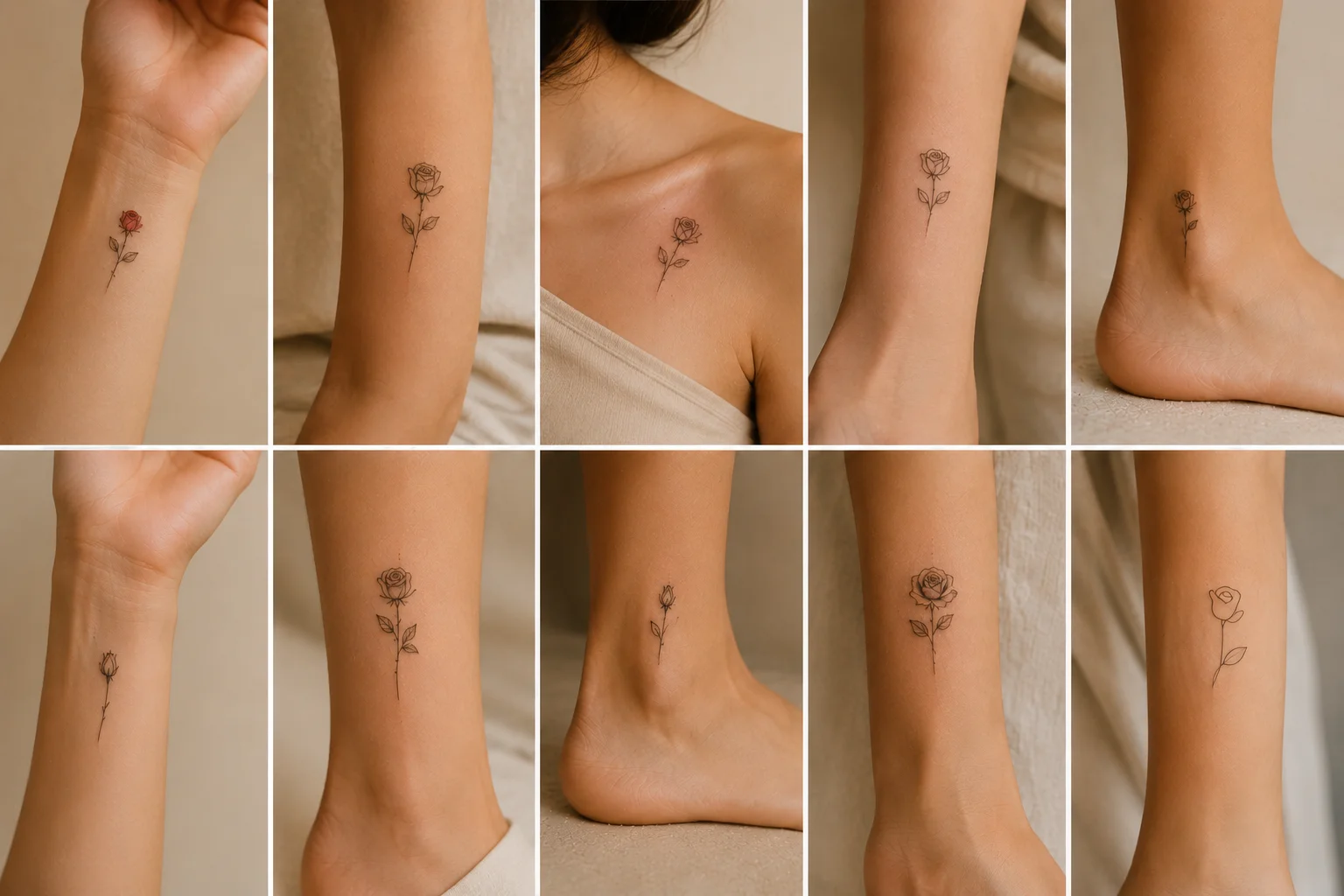
Rose Outline Tattoo
A rose outline tattoo uses contour lines without heavy shading.
This style sits between minimalist and illustrative tattooing.
It can work particularly well on the forearm, ankle or upper arm, where the artist has enough space to keep the petal shape readable.
Realistic Rose Tattoo
A realistic rose tries to reproduce the flower’s depth, petal structure and natural shading.
Roses vary significantly in shape: RHS botanical material describes rose flowers as flat, cupped, rounded, urn-shaped, pompon-like or rosette-shaped depending on the variety.
That variety gives realistic designs plenty of visual options.
Realism usually benefits from more space. Good placements include:
- Shoulder
- Upper arm
- Forearm
- Thigh
- Back
A larger canvas allows the tattoo artist to create depth without forcing too many details into a small area.
Traditional Rose Tattoo
Traditional rose tattoos usually use stronger outlines, simplified petal forms and bold color.
They often feel more graphic than realistic roses.
A classic traditional rose can stand alone or combine with:
- Dagger
- Snake
- Heart
- Banner
- Swallow
The traditional style works well when you want the rose to read clearly from a distance.
Blackwork or Black-and-Grey Rose Tattoo
Blackwork and black-and-grey roses shift attention away from flower color and toward shape, texture and contrast.
A black-and-grey rose can feel:
- Dramatic
- Elegant
- Moody
- Memorial
- Botanical
The absence of bright color does not automatically create a darker meaning. The symbolism still depends on the person wearing it.
Rose Bouquet Tattoo
A bouquet allows one rose to become part of a larger story.
You might combine roses with:
- Birth flowers
- Wildflowers
- Lavender
- Daisies
- Peonies
- Leaves
- Personal symbols
A bouquet generally works better at medium or larger scale because multiple flowers need room to remain distinct.
Rosebud Tattoo
A rosebud can represent a beginning, possibility or something still developing.
Its shape is also naturally compact, making it useful for small placements.
A rosebud could mark:
- A new chapter
- A birth
- A first tattoo
- Personal growth
- A young relationship
- A milestone still unfolding
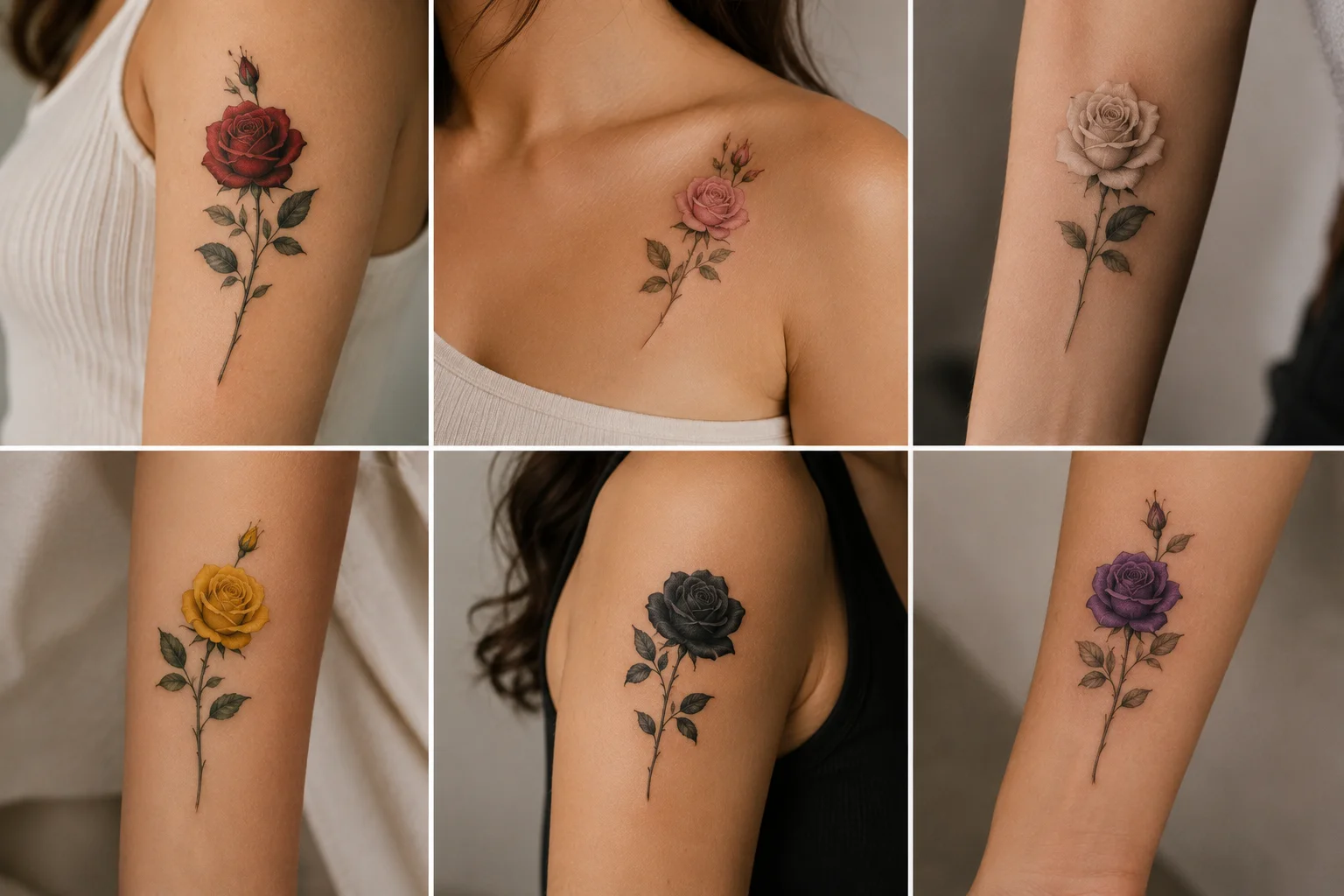
Rose Tattoo Color Meanings
Rose color symbolism can be useful inspiration, but it should not be treated like a universal code.
Historical floriography assigned different meanings to different colors, while modern interpretations have continued to evolve. The Metropolitan Museum of Art notes that flower meanings were influenced by religion, mythology, appearance and social traditions rather than one consistent system.
Red Rose Tattoo
A red rose is commonly associated with love, romance and passion.
Kew describes red roses as iconic symbols of love, and RHS material similarly connects them with romantic love.
A red rose tattoo might suit someone marking:
- A romantic relationship
- An anniversary
- Love for a family member
- A powerful emotional memory
It can also simply be chosen because red creates strong visual contrast.
Pink Rose Tattoo
Pink roses are commonly associated with admiration, gratitude, affection and joy in modern flower symbolism.
As a tattoo, pink gives a rose a softer visual character than deep red or black.
Someone might choose pink for:
- A sentimental memorial
- A family connection
- A gentle floral composition
- A design centered on affection rather than romance
White Rose Tattoo
White roses can be associated with truth, innocence, purity or remembrance depending on context.
Historical meanings vary considerably. Medieval Christian symbolism, for example, gave white roses specific religious associations that should not automatically be transferred to modern tattoos.
If you want a white rose tattoo primarily for aesthetic reasons, discuss visibility and contrast with your artist. White tattoo ink is visually different from simply depicting a white rose using negative space and shading.
Yellow Rose Tattoo
Yellow roses are often associated today with friendship, caring, happiness or warmth. RHS educational material uses friendship and caring as common yellow-rose meanings.
However, yellow roses have carried different associations at different points in history.
For a tattoo, your own reason for choosing the color matters more than finding one supposedly official definition.
Black Rose Tattoo
A black rose tattoo does not automatically mean death.
People may use a dark rose to express:
- Remembrance
- Change
- Grief
- Strength
- Mystery
- Ending one chapter
- Beginning another
There is also a practical botanical distinction: RHS notes that natural roses occur in many colors but not true black.
So a black rose tattoo is primarily an artistic interpretation rather than a literal botanical representation.
Purple Rose Tattoo
Purple roses may be used in tattoos to suggest individuality, mystery, elegance or simply a preference for the color.
Modern rose cultivars do exist in purple tones, but symbolic interpretations are less standardized than those commonly attached to red, pink, white or yellow roses. RHS describes roses as occurring in shades that include purple among many other colors.
If purple has a personal association for you, that may be the strongest reason to use it.
Rose Tattoo Styles
The same rose can feel completely different depending on the tattoo style.
Fine-Line
Fine-line roses emphasize delicacy.
They often use:
- Thin contours
- Minimal shadows
- Fine stems
- Light botanical details
They work well for small and medium designs.
Minimalist
Minimalist roses focus on simplicity.
A few lines may suggest the bloom rather than reproducing every petal.
This style is useful for wrists, ankles, inner arms and other compact placements.
Traditional
Traditional designs rely on strong outlines and simplified shapes.
They usually create a bold visual statement and can hold their form effectively at medium scale.
Realistic
Realistic roses emphasize petal depth, shadow and natural form.
They usually need more space than minimalist designs.
Black and Grey
Black-and-grey tattooing focuses on contrast instead of flower color.
It works especially well for realistic roses, memorial pieces and larger compositions.
Botanical
A botanical rose looks more like a plant illustration than a symbolic icon.
The tattoo might include:
- Natural petal structure
- Leaves
- Thorns
- Stem
- Buds
- Multiple stages of bloom
If botanical accuracy matters to you, use reference images of an actual rose variety.
Geometric
Geometric designs combine organic rose petals with structured shapes.
Possible additions include:
- Circles
- Triangles
- Symmetrical linework
- Frames
This creates contrast between natural and mathematical forms.
Single-Needle
Single-needle rose tattoos can create extremely fine detail and delicate linework.
This technique is best discussed directly with an artist experienced in that style because the amount of detail that works depends on size, placement and execution.
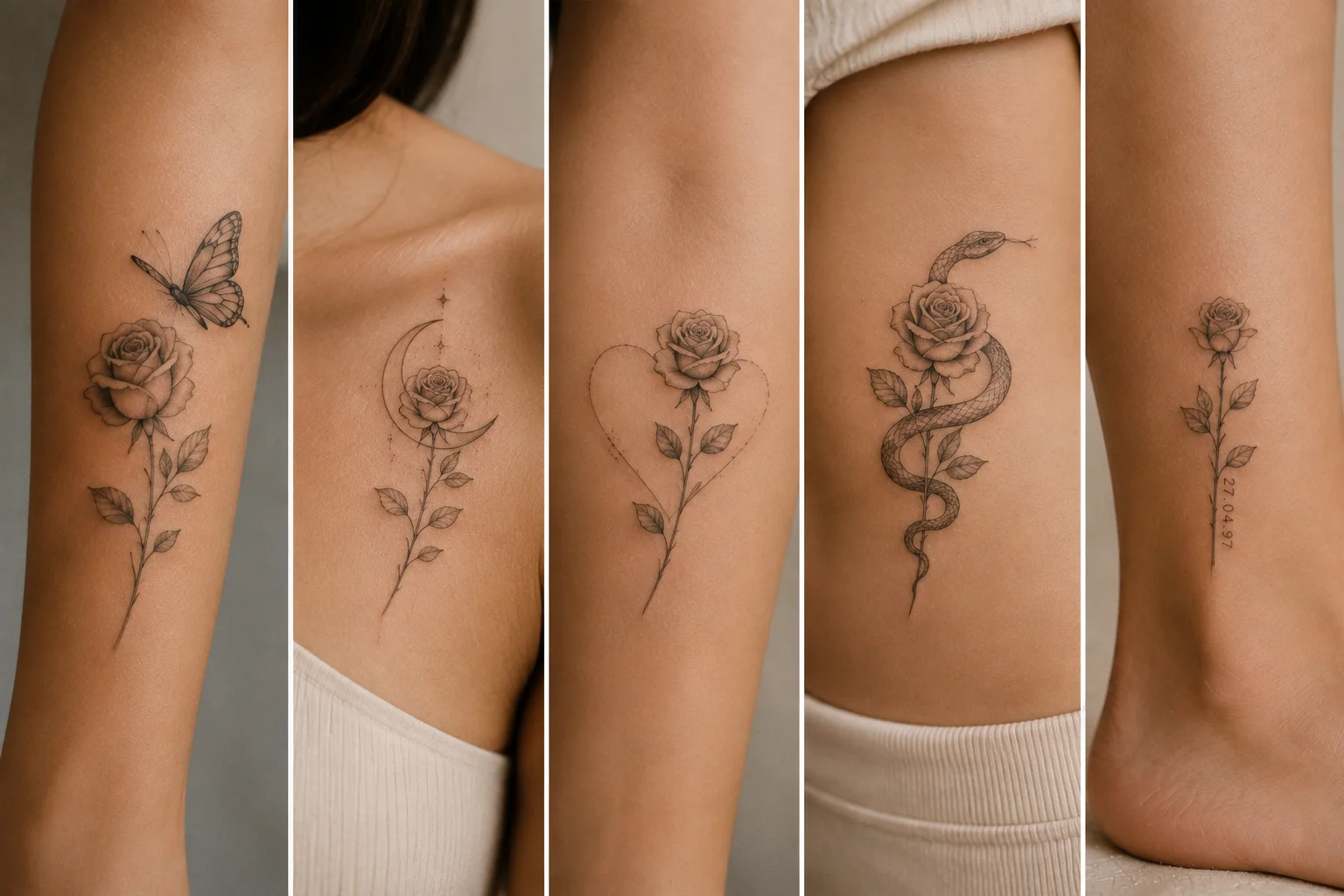
Rose Tattoos With Other Symbols
Adding another symbol can make a rose tattoo more personal.
The combination should tell a story rather than simply add decoration.
Rose and Butterfly Tattoo
A rose and butterfly can represent beauty, growth or transformation.
The rose may represent a person or memory while the butterfly adds a sense of change.
A medium forearm, shoulder or thigh design gives both elements enough room to remain distinct.
Rose and Moon Tattoo
A rose with a moon can create a softer, reflective composition.
Some people use the moon to represent cycles or change while the rose represents a relationship, memory or personal growth.
There is no single official meaning for this pairing.
Rose and Heart Tattoo
A rose and heart naturally emphasize emotional themes.
This combination can represent:
- Love
- Family
- Romance
- Self-love
- Remembrance
If you are choosing a design connected to a partner, PureInk’s couple tattoo ideas can help you explore ways to make the relationship element more specific.
Rose and Snake Tattoo
The contrast between a rose and a snake creates visual tension.
People may interpret the combination as:
- Beauty and danger
- Change
- Duality
- Attraction and caution
- Strength after difficulty
Those are possible personal readings, not universal symbolism.
Rose and Dagger Tattoo
A dagger cutting through or sitting behind a rose creates a strong contrast between softness and sharpness.
Someone might interpret the pairing as:
- Love and pain
- Protection
- Loss
- Strength
- Conflict
The design works especially well in traditional tattoo styles.
Rose With a Name or Date
A name or date turns a general rose symbol into something unmistakably personal.
It might mark:
- A birth
- Anniversary
- Wedding
- Memorial
- Family connection
Placement should leave enough room for lettering to remain clear.
Rose With Another Birth Flower
Combining a rose with another birth flower can represent two people, multiple family members or different stages of life.
For example, a rose can be paired with a lotus if the two flowers represent different ideas in your story. PureInk’s lotus tattoo meaning guide explores lotus symbolism in more detail.
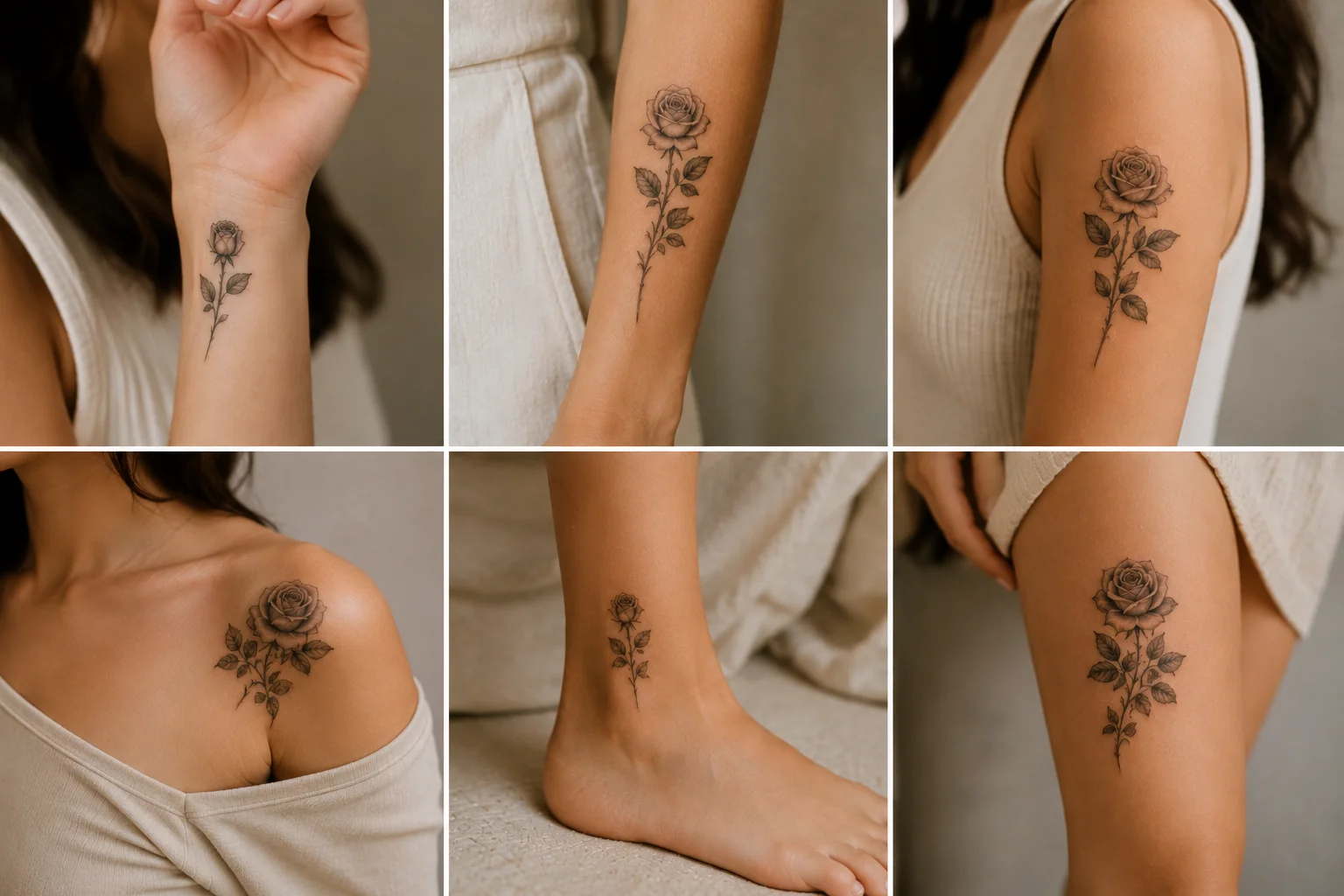
Best Placements for a Rose Tattoo
Roses work across both compact and elongated placements because the bloom can be simplified while stems and leaves can extend to follow the body.
The best placement depends on how much detail you want and how visible you want the tattoo to be.
Wrist
The wrist works best for:
- Tiny roses
- Rose outlines
- Rosebuds
- Fine-line single stems
Keep the design relatively simple because the available area is limited.
Forearm
The forearm is one of the most flexible locations for a rose.
Vertical arrangements work particularly well here.
Upper Arm
The upper arm provides more space for larger designs.
- Traditional roses
- Realistic roses
- Black-and-grey work
- Rose clusters
The natural curve of the arm can also support wraparound leaves or stems.
Shoulder
The shoulder works well for open blooms.
A rose can sit at the center while petals, leaves or secondary flowers extend outward.
This placement can accommodate more detail than the wrist or ankle.
Collarbone
The collarbone suits long, light compositions.
A single stem or delicate botanical rose can follow the line of the collarbone without requiring a large tattoo.
Ankle
An ankle rose usually works best when kept small.
- Rosebud
- Minimal stem
- Tiny botanical rose
- Small outline
Thigh
The thigh offers enough space for detailed artwork.
Rib Area
The rib area suits elongated rose compositions.
A stem can follow the vertical shape of the body, while the bloom remains the main focal point.
Back or Spine
The back allows much larger rose compositions.
A spine design can use one central rose with botanical or geometric elements extending vertically.
The broader back can hold bouquets, several roses or complex symbolism without crowding the design.
Small and Minimalist Rose Tattoo Ideas
Small roses work best when the design is built for a small scale instead of shrinking a large illustration.
Good concepts include:
- Tiny single-stem rose
- Micro rose outline
- Single-line rose
- Small rosebud
- Rose with an initial
- Rose with a date
- Delicate wrist rose
- Ankle rose
- Small botanical sprig
The key is spacing.
A very small tattoo with dozens of tight petal lines may look detailed on a phone screen but lose visual clarity when translated onto skin.
For more small, understated inspiration, the broader Floral Tattoo Ideas guide covers minimalist floral styles alongside other flower types.
If you are considering a rose for your first piece, PureInk’s first tattoo ideas with meaning can help you think through size, placement and personal significance before committing.
Meaningful Rose Tattoo Ideas
A rose becomes more meaningful when the design tells a story that belongs to you.
Instead of choosing “red rose = love” and stopping there, consider what specific relationship or experience you want the tattoo to represent.
You could personalize a rose with:
- A birth date
- Anniversary date
- Initials
- Handwritten word
- Coordinates
- Multiple roses for family members
- A particular rose variety
- Another birth flower
- Memorial details
- A symbol connected to an important event
Multiple Roses for Family
Several roses can represent different people.
You might use:
- One bloom per person
- Different stages of bloom
- Different colors
- Several varieties
This creates a family tattoo without requiring names.
Rose With Handwriting
A handwritten word from someone important can make a rose deeply personal.
The text might sit beside the stem or become part of the composition.
Memorial Rose
A memorial rose can include:
- Date
- Initial
- Name
- Small object connected to the person
- Handwriting
- Another symbolic flower
There is no need to rely on a particular rose color unless it has meaning to you.
How to Choose a Rose Tattoo That Feels Personal?
A good rose tattoo starts with the story, not the Pinterest image.
1. Decide What the Tattoo Should Represent
Ask yourself what you want to remember when you look at the tattoo.
Why this matters: This gives the design direction.
2. Choose Whether Meaning or Style Matters More
Some people care most about symbolism.
Others simply love the shape of roses.
Both approaches are valid.
Knowing which matters more helps you make decisions later.
3. Decide Whether Color Adds Meaningful Value
Ask whether the color itself is important.
If red represents a particular relationship, use it intentionally.
If color does not matter, black-and-grey may keep the design visually focused.
4. Choose the Tattoo Style
Decide which visual direction feels most like you.
5. Match the Detail to the Size
The smaller the tattoo, the simpler the design usually needs to be.
Do not choose the amount of detail first and then force it into an unsuitable size.
6. Choose a Placement That Supports the Shape
Forearm, ribs or calf
Shoulder or thigh
Wrist or ankle
7. Ask the Artist to Create an Original Composition
Use tattoo references to communicate style, not to copy another artist’s work exactly.
Bring examples of:
What to Consider Before Getting a Rose Tattoo?
Rose tattoos can range from very simple to extremely detailed, so design planning matters.
Petal Complexity
Roses have layered petals.
If you want a tiny tattoo, reduce the number of internal lines rather than trying to reproduce a realistic flower at micro scale.
Line Spacing
Clear negative space helps individual petals remain visually distinct.
This matters especially in fine-line and small designs.
Size
Match the tattoo size to the style.
A detailed realistic rose generally needs more room than a simple outline.
Color vs. Black and Grey
Color can add symbolism and visual impact.
Black and grey shifts the focus toward form and shading.
Neither option is automatically more meaningful.
Placement
Think about:
- Visibility
- Available space
- Clothing
- How the design follows the body
- Whether you may expand the tattoo later
Future Readability
Ask your tattoo artist whether the line spacing and detail level make sense at your chosen size.
Artist Style
Choose an artist whose portfolio already shows the type of work you want.
Someone experienced in traditional roses may not be the ideal choice for delicate botanical realism, and vice versa.
Aftercare Planning
Before your appointment, understand the basic healing process and follow the instructions provided by your tattoo professional.
For a fuller overview, read PureInk’s tattoo aftercare guide.
Frequently Asked Questions
A rose tattoo can symbolize love, beauty, affection, remembrance, passion, growth or personal transformation. The meaning depends on color, style, accompanying symbols and personal interpretation. Historically, roses have carried many meanings rather than one universal definition.
A red rose tattoo is commonly associated with love, romance and passion. Red roses have a strong historical and modern relationship with romantic symbolism, but a tattoo can also represent family, remembrance or another personal connection.
A black rose tattoo can represent loss, remembrance, transformation, mystery or strength, depending on the wearer. It does not always mean death. True black roses do not naturally occur, so a black rose is primarily an artistic interpretation rather than a literal botanical color.
Yes. A rose can work well as a first tattoo because it can be simplified into a small outline or expanded into a larger design later. Beginners should match the detail level to the intended size and choose a placement they are comfortable with.
No. Rose tattoos can be pink, yellow, purple, white, black-and-grey or any other artistic color. Natural rose cultivars also occur in many shades beyond red.
Common combinations include butterflies, moons, hearts, snakes, daggers, dates, names and other flowers. The best combination is the one that adds meaning or visual balance rather than simply filling space.
Final Thoughts
The best rose tattoo is not defined by one color, one meaning or one popular style.
A strong design brings together symbolism, visual style, scale, placement and personal significance.
You might choose a fine-line rose because you prefer something subtle. You might choose a realistic rose tied to someone important. A black-and-grey rose might mark transformation, while a red one may represent a relationship.
The flower gives you the starting point.
Your story determines the final design.